
Selling a used car in Canada is a part-time job nobody applied for.
You take the photos, write the listing, and guess at a price. Then the messages start. “Is this still available?” Then they vanish. Someone books a test drive and doesn’t show. Someone else shows up and offers $3,000 under asking, “cash, today.” Around week three, you start wondering if the extra money is worth the headache.
Usually it isn’t. Clutch built a business in that gap.
I’ve used Clutch myself, so here’s a quick case study on why it works, and where it’s harder than it looks.
The pain point
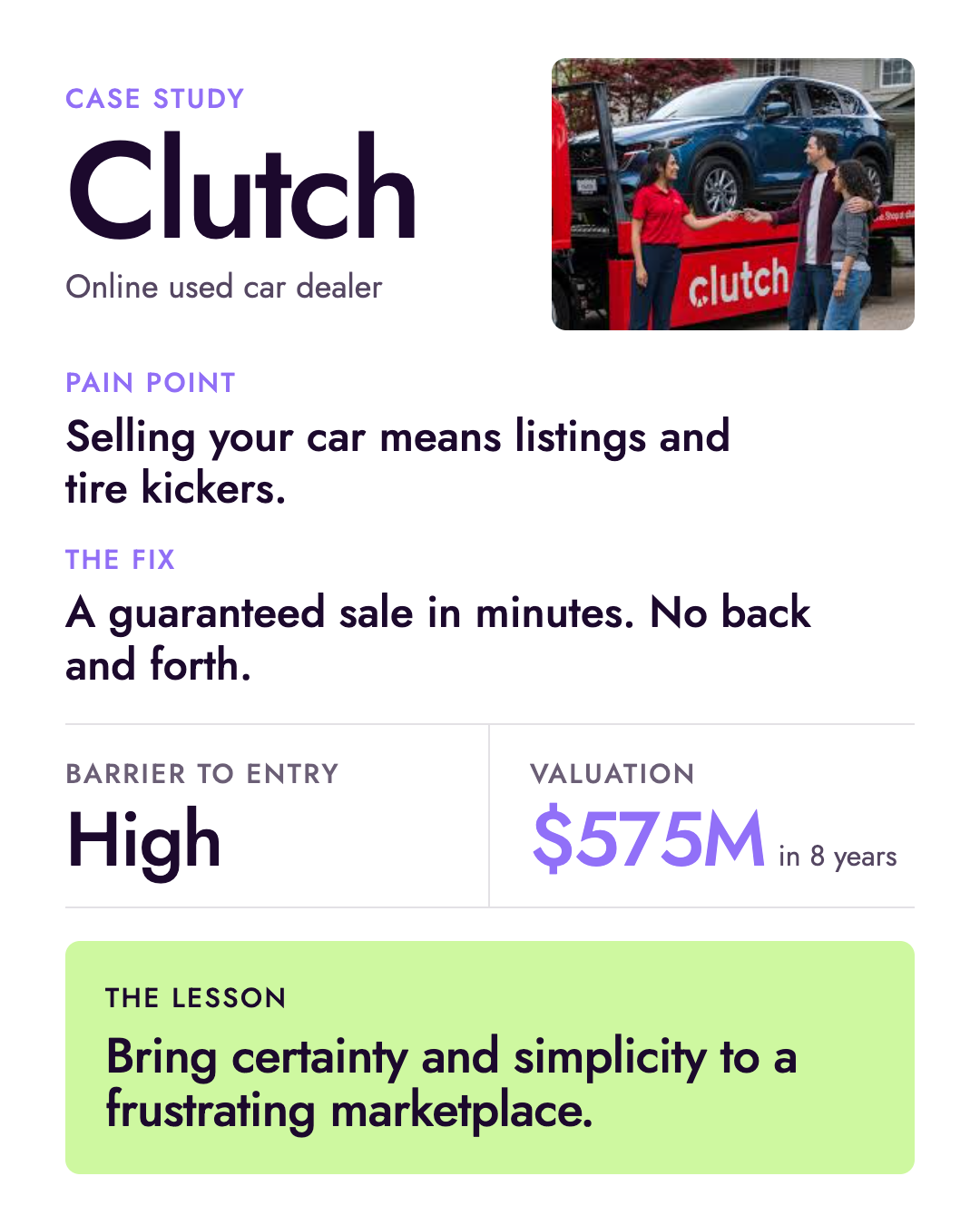
Selling your car takes time and effort, and most of that effort goes to people who were never going to buy. The work itself isn’t the hard part. The uncertainty is.
How Clutch solves it
You enter your car’s details online, get a firm offer in minutes, and if you accept, they handle the rest. There’s no haggling, no strangers in your driveway, and no “what’s your lowest price?” at 11 p.m.
Clutch isn’t selling a better price. In a lot of cases, you’d get more money from a private sale. What it sells is certainty: you know what you’ll get, when you’ll get it, and that nobody’s going to flake.
What it replaces
Look at the alternatives: AutoTrader, corporate dealerships, used car lots, Kijiji, Facebook Marketplace, and your uncle’s friend who “knows a guy.” Each one comes with a catch. You get negotiation, a lowball trade-in, sketchy buyers, or an awkward Thanksgiving.
Clutch didn’t beat them on any single feature. It beat them on the experience.
The barrier to entry is high
This isn’t an app you spin up over a weekend. To make a firm offer in minutes, you need pricing data you trust and cash to buy inventory. You need facilities to inspect and recondition cars, logistics to pick them up and deliver them, and financing for buyers on the other end. All of that is expensive, which is exactly why it’s hard to copy.
Clutch was valued at about $575M in 2021, and its 2025 raise put it slightly above that, roughly eight years after it started.
Now, the honest part
It hasn’t been a straight line up. In 2023, after a planned financing fell through, Clutch cut about 65% of its staff and pulled out of Western Canada. The capital-heavy model that keeps competitors out also makes the business fragile when money gets tight.
So “make it simple” isn’t a magic formula. Simplicity for the customer usually means complexity and cost for the business. Someone has to absorb the risk. Clutch chose to, and nearly paid for it.
The lesson
You win by bringing certainty and simplicity to a market people already hate dealing with.
You’ve seen this play before. Uber took the guesswork out of getting a ride. Airbnb made staying in a stranger’s home feel predictable. Expedia put flights and hotels in one place with one price. eBay gave strangers enough reason to trust each other.
None of them invented the product. They removed the friction around it.
So here’s the question I’d ask about your business: where do your customers feel uncertain? It might be pricing, wait times, or not knowing what happens next. That’s probably your opening.
Be honest about what it costs to close that gap. Certainty is worth paying for. Just make sure you can afford to deliver it.