
An AI is describing your brand right now. You've never read it.
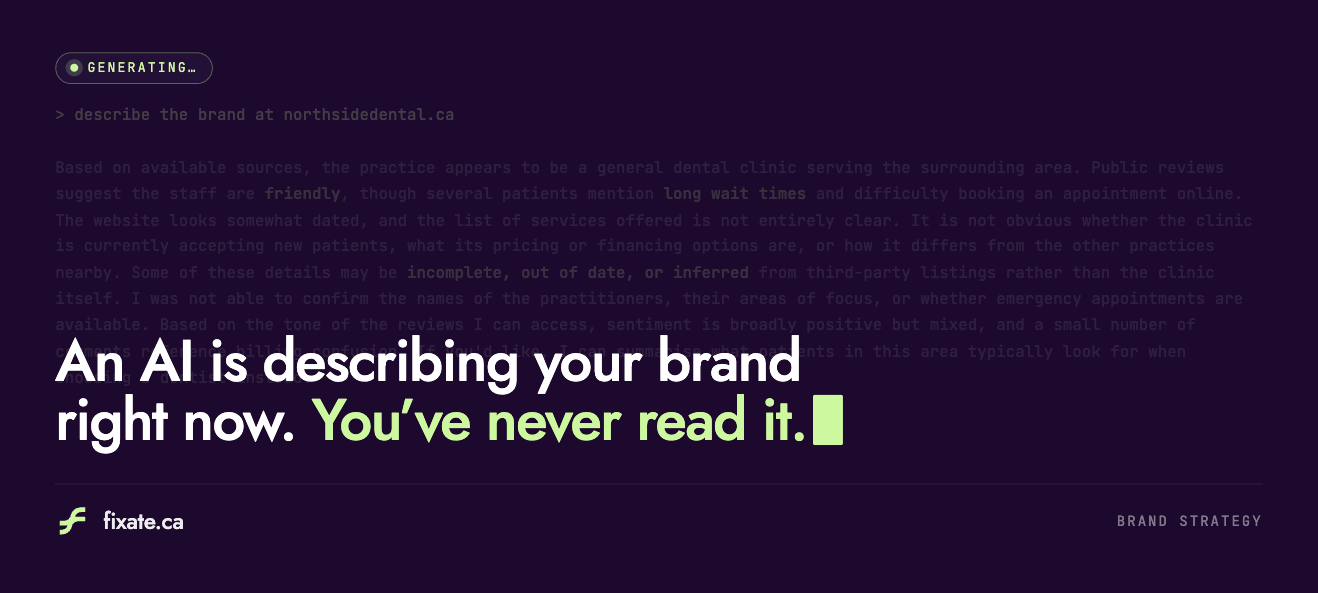
Go open ChatGPT and type "what's the best [your category] in [your city]." I'll wait.
Read what it says about you. That paragraph, the one you didn't write, didn't approve, and have probably never seen, is doing brand work for you right now. It's shaping what a potential customer thinks before they ever hit your website. And here's the part nobody wants to say out loud: most brand leaders have no idea what's in it.
I want to make an argument that's going to sound boring, and I mean that as a compliment. Everyone's treating AI brand visibility like it's a new and terrifying discipline that requires a new and terrifying budget line. It isn't. It's the same brand fundamentals you already know, pointed at a surface you've been ignoring.
What's actually happening
People stopped clicking and started asking. When someone wants a recommendation now, a lot of them skip the ten blue links entirely and just ask a chatbot to decide for them.
The scale is real, not hype. OpenAI's Sam Altman said ChatGPT hit 800 million weekly users in October 2025, and OpenAI reported it passed 900 million by early 2026. Google's AI Overviews (the AI summary that sits on top of search results) show up somewhere between a quarter and well over half of all searches, depending on whose tracker you believe. (That range is wide on purpose; everyone measures it differently, and anyone quoting you a precise number is guessing with confidence.)
Gartner predicted back in 2024 that traditional search volume would drop 25% by 2026 as people shift to AI assistants. Worth noting: Gartner itself called that scenario modeling, not a sure thing. I'm not going to pretend it's gospel. But you don't need the exact figure to be true to see the direction of travel. The behavior has already changed. You've done it yourself.
Why this is a brand problem, not a tech problem
Here's where I think people get it wrong. They hear "AI" and "search" in the same sentence and file it under SEO, a technical problem for the web team to solve with the right keywords and some schema markup.
It's not that. When an AI answers a question about you, it isn't just listing you. It's characterizing you. It decides your tone, your strengths, your weaknesses, who you're "good for" and who you're not. It writes a little verdict. That verdict is brand positioning, and right now a machine is doing it on your behalf, based on whatever it happened to read.
That's not an SEO job. That's the exact work you already do every time you write a tagline, train a front-desk team, or decide what your brand stands for. The only thing that's new is the room it's happening in.
The 20-minute audit
You don't need a vendor for this. You need 20 minutes and a bit of honesty.
Ask three or four AI tools (ChatGPT, Gemini, Perplexity, whatever you've got) the same handful of questions a real buyer would ask. "Best [category] in [city]." "Is [your brand] any good?" "Alternatives to [your competitor]." Ask it the awkward ones too.
Then read the answers like a customer would, and sort what you see into four buckets: what's accurate, what's stale, what's flat-out wrong, and what's missing entirely. While you're at it, notice what the AI is leaning on: your own site, a directory listing, a third-party review, an old article. That tells you where the machine is getting its impression of you.
That's the whole audit. It's not clever. It's just looking, which is more than most of your competitors have done.
What to do with what you find
Now the genuinely unglamorous part, and the reason I keep saying this is just brand fundamentals.
You fix the inputs. The AI is reading your website, your profiles, your listings, your reviews, the things other people have written about you, and yes, your LinkedIn. If those sources are consistent, clear, and tell a straight story about who you are, the machine tends to repeat it. If they're a mess of stale bios, half-finished profiles, and three different descriptions of what you do, the machine improvises. And you will not like its improv.
So: make your story consistent everywhere a human or a bot might read it. Keep your facts straight across every surface. Publish things that actually say something, because substance gets picked up and filler gets ignored. None of that is a 2026 AI tactic. It's the brand hygiene you were supposed to be doing anyway. The AI just raised the cost of skipping it.
The honest caveat
I'm not going to oversell this, because plenty of people already are.
You cannot fully control what an AI says about you. The answers shift constantly, the models change without warning, and there is a whole new industry selling "generative engine optimization" with the confidence of people who have figured out something they have not figured out. Be skeptical of anyone promising guaranteed AI rankings. That's the new version of guaranteed page-one Google, and it was a bluff then too.
What you can do is improve the inputs and check the outputs. That's it. That's the job. The counter-argument, that this is all overblown and you should wait until it settles, has a real point: it is genuinely early and genuinely noisy. But "wait and see" only costs you nothing if your competitors are waiting too. They're not all waiting.
The takeaway
The machines are already describing your brand. The only question is whether the description is one you'd have signed off on, or one they made up because you weren't paying attention.
Go read your paragraph. Then decide if you like it.
Filed under: things that look like a tech problem and are actually a brand problem.
#brandstrategy #AI